Most rail organisations are now “doing AI” in some form. A pilot for predictive maintenance. A dashboard for delays. A vendor demo of a vision system. A chatbot trial to sift documents.
The common failure mode is not lack of ambition — it is lack of translation. AI work often stalls at the point where someone asks the unglamorous questions: What problem are we actually solving? What data is fit for purpose? How do we assure it? Who owns the risk? How do we stop it becoming an unmaintainable science project?
That gap between “AI curiosity” and “operational adoption” is exactly what needs to be closed.
This Is Not Another Generic AI Course
This is aimed at professionals in rail who need to make AI decisions that stand up in the real world: engineering leaders who have to sign off requirements, operators who need to trust the outputs, and technical teams who will be held accountable when the system is audited, challenged, or fails.
The premise is straightforward: if AI is going to influence safety, performance, availability, or cost in rail, then it must be treated like an engineered system — not a clever add-on.
That means three things.
1. Anchor AI to Specific Railway Use Cases with Clear Value
Predictive maintenance is an obvious example, but “predictive” only matters if it reduces disruption, improves planning, and changes decisions. Traffic optimisation is another — useful only if it improves punctuality, capacity, and resilience without creating brittle dependencies.
Condition monitoring, anomaly detection, and real-time analytics are all attractive, but only if you can separate signal from noise and avoid drowning staff in false alarms.
The right approach to these themes always starts from the same place: what would you actually do on Monday morning? What to measure, what to expect, how to validate, and how to avoid the usual traps.
2. Govern and Assure AI Properly
In rail, it is not enough to say “the model works” or “the accuracy is good.” You need to know:
- What the model does under edge conditions
- How it degrades gracefully
- How bias and data drift are handled
- How it is monitored in production
- How you evidence decisions made with its outputs
You also need to understand how assurance expectations change when AI is used to inform decisions versus when it directly drives them. Governance, risk, and assurance are core engineering topics here — not optional ethics slides bolted on at the end.
3. Deploy AI in the Ecosystem You Actually Have
Rail is document-heavy, standards-driven, and full of legacy complexity. One of the most practical opportunities right now is the use of large language models to reduce friction in assurance and compliance: searching and structuring evidence, checking consistency, mapping requirements, and supporting reviews.
Done well, this can shorten cycles and improve quality. Done badly, it creates unverifiable outputs and new risk.
The pragmatic view is this: understand where LLMs genuinely help, where they do not, and how to use them in a controlled, auditable way.
What Good Looks Like
If your organisation has reached the point where AI has moved from novelty to necessity, the goal is adoption that is credible, safe, and defensible. That means coming away with clarity on:
- Which AI use cases are worth pursuing in your part of the railway
- What “good” looks like in data quality, validation, and monitoring
- How to build an implementation roadmap that leadership can fund and assurance teams can support
The delivery format is designed for working professionals — structured self-paced learning combined with live sessions that force engagement with the material, challenge assumptions, and connect it back to your own operational context.
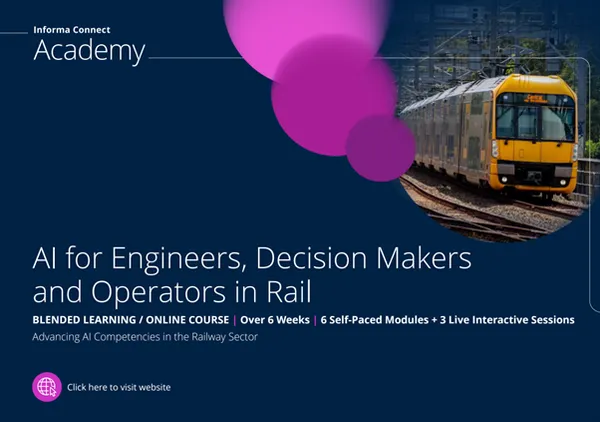
Digital Transit Limited has partnered with Informa to deliver AI for Engineers, Decision Makers and Operators in Rail — a 6-week blended learning programme helping rail professionals move from AI curiosity to operational adoption.